Monday, July 30, 2012

KHFMA's 3rd Birthday Bash!


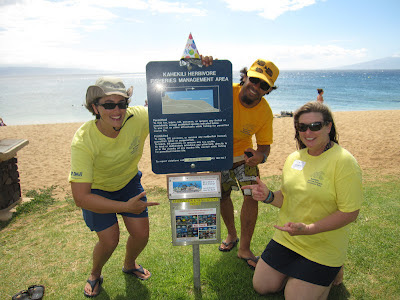
The Kahekili Herbivore Fisheries Management Area’s third annual Birthday Bash celebration was held the last weekend of July at Kahekili Beach Park. Why not throw a birthday party for a Marine Managed Area?! Thanks to everyone who was part of our event, and thanks for wearing the birthday hats – it’s a tradition – even the KHFMA sign wears one.
The past two years we have held a potluck and conducted several educational and citizen science activities during the day, and this year decided we’d try to top last year’s festivities. Of course a main objective of the Birthday Bash was to raise awareness about the KHFMA and why it exists, so we wanted to make sure its themes of marine conservation and community involvement were well represented throughout all the festivities.
Through outreach stations and partygoing volunteers, beachgoers and participants had the opportunity to learn about the efforts of the Ka’anapali Makai Watch program, jointly coordinated by Division of Aquatic Resources (DAR), the Coral Reef Alliance, and Project S.E.A.-Link. The Hawaiian Islands Humpback Whale National Marine Sanctuary outreach team was also onhand with an education station to talk to visitors and community members about their efforts. 
There were many people wearing yellow shirts – either in support of the Herbivore Enhancement Area (HEA) citizen science program coordinated by DAR, or our awesome team of Ka’anapali Makai Watch volunteers, who are out there talking to visitors, fishers, other community members, and serving as excellent “box-parents” to help get the word out about the KHFMA.

The Birthday Bash featured training on the HEA fish grazing surveys, and an in-water reef tour by DAR biologist (and Ka’anapali Makai Watch co-coordinator) Darla White, who took participants out to observe firsthand some key features of the reef at Kahekili – examples of healthy versus degraded reef, the “dead zones,” grazing herbivores, and the freshwater seeps which have been linked to the treated effluent from the Lahaina Wastewater Reclamation Facility. Nothing takes the place of experience, and as Darla puts it, “you’ll see the reef through new eyes” after joining us in the water. 

Luna Kekoa, NOAA Coral Fellow and Ka’anapali Makai Watch co-coordinator, created and shared several interpretive displays to communicate the outcomes of the Creel fishing effort surveys conducted last year, and to convey a sense of place and provide a proper cultural context for the area. He also taught people about different types of fishing gear and their traditional usage, through interactive demonstrations. Many people had the chance to try throw-netting thanks to Luna’s instruction!


Environmental Scientist Robin Knox set up a water quality “talk story” station, and engaged volunteers and community members in dialogue on relevant water quality issues. The team also conducted some turbidity sampling together, and discussed the results. Robin wrote up a great blog post about the experience, and explained some of the technical considerations that go along with “standards” and “criteria,” as these themes can be complicated, but have serious implications. The exciting outcome from the event is that there seems to be a renewed interest in establishing a more ongoing community-based water quality  monitoring program for West Maui. Stay tuned for more on that…
The event also featured a team of divers conducting REEF’s Great Annual Fish Count, the 12th to be held on Maui and the 21st overall! A crew from the Fish Identification Network and Maui Ocean Stewards made sure no fishes went uncounted that day.
Last but not least, one of the highlights from last year’s Birthday Bash were the manini and “phase shift” cakes and the seaurchin cupcakes made by the research team from Scripps Institution of Oceanography. Their level of geeky awesomeness inspired us to develop a KHFMA-themed culinary contest for this year’s Birthday Bash. To be quite honest we had no idea how to run a culinary contest, but it sounded like a fun thing to try, that would also serve an education and outreach function. We came up with some categories  - “Hebivory/Grazing,” “KHFMA General,” “Best Use of Limu,” and “Science Geekiest,” and put the word out. We enlisted a VIP Guest Judging panel consisting of chefs from local Ka‘anapali area hotels - Chef David Roshenski from the Westin Ka‘anapali Ocean Resort, Chef Pavy Keomaniboth from the Hyatt Regency Maui Resort & Spa, and Chef Jojo Vasquez from the Banyan Tree at the Ritz Carlton Kapalua Resort; as well as professionals within the science, education and conservation community, including: Robin Knox (Water Quality Consulting, Inc. & Aquanimity Now), Dr. Mark Deakos (Hawaii Association for Marine Education and Research), Erin Iberg (Maui Ocean Center), Ka’au Abraham (Hawaiian Islands Humpback Whale National Marine Sanctuary), Tova Callender (West Maui Ridge to Reef Initiative), and Eve Clute (West Maui Sustainability). We received donations of prizes from the Westin Ka’anapali Ocean Resort Villas, the Ritz Calrton Kapalua, the Hyatt Regency Maui Resort & Spa, the Royal Lahaina, Trilogy Excursions, and Maui Sporting Goods. With all the pieces in place, we then put the word out.
What we didn’t quite expect was the 22 entries, and the amazing level of creativity that was on display! Check out the photos on the voting album that was posted on facebook; there are even more photos in the general album.


Congratulations to all the winners! Here they are below, listed by category:
KHFMA General: 1st Place: Lindo Castro; 2nd Place: Veronica Sylva
Herbivory/Grazing: 1st Place: Sheila Murphy; 2nd Place: Audrey Dack
Best Use of Limu: 1st Place: Maria Demarest; 2nd Place: Luna Kekoa
Science Geekiest: 1st Place: Levi Lewis (check out his blog post here!); 2nd Place:  Eve Clute
Most Creative: 1st Place: Judy Lauridson; 2nd Place: Sheila Murphy
Best Overall (including Judging Panel, community participants, and facebook voters): Maria Demarest; runner up - Linda Castro

So again, MAHALO to all of those who came out in support of the Kahekili Herbivore Fisheries Management Area, and made our 3rd Birthday Bash a fun success! We also want to acknowlegde our amazing team of outreach volunteers who help spread the word about the KHFMA all the time, and those who are helping with the monitoring efforts as citizen scientists. You all know who you are, and you all are awesome and inspirational!!

We have a year ahead of us to figure out what to do for the 4th Birthday Bash – if you have any creative ideas, please post them on our facebook wall!


photos in this post contributed by Darla White, Donna Brown & Liz Foote

Wednesday, July 18, 2012

Scientists Respond to NYT Op-Ed: A World without Coral Reefs


Aloha all,

Last week an Op-Ed in the New York Times, "A World Without Coral Reefs" by Roger Bradbury  (http://www.nytimes.com/2012/07/14/opinion/a-world-without-coral-reefs.html?_r=1) went viral.  He referred to coral reefs as "zombie ecosystems, neither dead nor truly alive in any functional sense, and on a trajectory to collapse within a human generation."  I happen to strongly disagree with him on that point, as do others.  There are a lot of truths in his article and a conversation that needs attention, to be sure.  But especially here in Hawaii, we have hope for our reefs, and nature is amazingly resilient...IF we decide to be proactive about keeping them healthy, which means they need fish for ecosystem services such as reducing algal growth, and clean, clear, low nutrient water.

There have been some responses to the article that you should read from scientists like John Bruno, Jeremy Jackson, Carl Safina, and more.  I have included two blog responses of interest that I hope you take the time to read...I'll just include one brief excerpt but there is more, well worth your five minutes that it will take to read...because it is not all doom and gloom, but it is serious.  From John Bruno (excerpt):

The world’s coral reefs have indeed changed, are under enormous pressure, and their future is threatened.

But are they really “on a trajectory to collapse within a human generation”? No.

Is there really “no hope of saving the global coral reef ecosystem”? No, there is hope.

And is the “scientific evidence for this is compelling and unequivocal”? No, not remotely.

I think these are valid opinions, but they are not science, nor are they supported by science. 

http://theseamonster.net/2012/07/jeremy-jacksons-take-on-zombie-ecology/

http://dotearth.blogs.nytimes.com/2012/07/14/reefs-in-the-anthropocene-zombie-ecology/

Lanai, Photo by Darla White

Reefs are under significant pressure and there will be losses...it will be different.   Yes, many of our reefs are in decline and Hawaii is not immune to the warming ocean temperatures and ocean acidification, but healthy reefs will be more resilient to these pressures.  Our reefs are priceless for so many reasons, so we need to manage our reefs effectively, and we need communities to get involved and support proactive strategies for ensuring Hawaii's reefs will be around for the grandkids and beyond.

We all have to be good stewards. We can do something about overfishing, pollution, and sedimentation, and it starts with understanding that each and every person living on these islands can do something to make it better.  A positive place to start is by cutting back on your own CO2 emissions (electricity usage, meat consumption, fuel, buy local, etc.) and supporting renewable energy initiatives.  Be pono about fishing and take only what you need.  And remember, everything is connected mauka to makai, so think about the products you buy and use and how you dispose of things...all drains lead to the ocean.

Mahalo, Darla


Darla J White
Special Projects Coordinator
DLNR Division of Aquatic Resources, Maui
130 Mahalani Street, Wailuku HI 96793

Eyes of the Reef
Climate Change and Marine Disease Local Action Strategy
Island Coordinator, Maui
www.reefcheckhawaii.org/eyesofthereef

Cell: 808-281-4916
onareef@yahoo.com
darla.j.white@hawaii.gov

Saturday, June 30, 2012

Meet the KHFMA Box-Parents!

Have you heard of the Kahekili Herbivore Fisheries Management Area? Do you know what its rules and boundaries are? Do you know what a “herbivore” is? Can you identify the herbivores that are protected within the KHFMA in the image below?


These are simple but important questions, and in order to focus on promoting voluntary compliance with the unique set of rules within this relatively small  but highly significant area, education and outreach is needed.
That’s where Ka’anapali Makai Watch and our awesome team of volunteers comes in. We have established several ways of getting the message out about the KHFMA, which is coming up on its three-year anniversary of establishment. Having a presence at the site, whether it’s casually roving volunteers talking story with beachgoers and fishers, or establishing an outreach station at special events or in partnership with the nearby hotel the Westin Ka’anapali Ocean Resort, is one way that is effective.
However, our volunteer team came up with another strategy recently that we feel will make a difference, by providing a mechanism to distribute key information about the KHFMA and its rules.

The DLNR KHFMA sign on its own isn’t particularly engaging, and if someone doesn’t know what a “herbivore” is, or which fishes and invertebrates are within the protected families, it’s less likely there will be compliance, simply due to lack of awareness. And if someone who encounters the DLNR sign manages to get to the bottom without falling asleep or wandering off, they’ll miss the (somewhat convoluted) language that indicates that fish feeding is ILLEGAL in the area.
So, what you will see now on a number of signs within the KHFMA, is literature boxes with interpretive information attached to them, and the DLNR rules & regulations booklets inside.

This effort was spearheaded by the original “box-parents” John & Karen, who have been volunteering with Ka'anapali Makai Watch since 2009. They came up with the idea and caretake a box at Kahekili Beach Park by keeping it stocked with rules & regs booklets and other interpretive materials. The next thing we knew, we had a whole team step up to be box-parents at other signs’ locations, assisted immensely by Don “The Boxfather” McLeish, who engineered and piloted the setup of the durable stainless steel boxes he found. There were impressive architectural drawings involved, and lots of measuring, drilling, cutting and laminating. Our team worked together to refine the content for the boxes’ displays – the idea is to avoid giving out too much collateral material which could very well end up as debris. The boxes display colorful images of the protected species (donated by Keoki Stender), important phone numbers, and key reef etiquette pointers for visitors. We also posted a QR code that directs people to more official information online.
So, without further ado, let’s...


Karen & John, Kahekili:

Don, Embassy:

Julie & Mike, Honua Kai Park:


Terry & Marie, North Honoapi'ilani Park (between the Mahana and Honua Kai Resort):


Sofia & Sheila, Honokowai Park:

Mahalo to these amazing volunteers who are helping get the message out every day!!
If you’re interested in getting involved with Ka’anapali Makai Watch, “like” our facebook page or drop us a line, and join us for the 3rd Annual KHFMA Birthday Bash& Culinary Contest coming up this July!

Saturday, June 2, 2012

NOAA Marine Debris Program Tsunami Debris Presentation and Resources

I have been wanting to use this blog more to post summaries of community presentations, and figured that the talk presented last night by Carey Morishige, Pacific Islands Regional Coordinator of NOAA's Marine Debris Program, would be a good one to cover!


With all the media hype about the tsunami debris, and misperceptions about existing marine debris issues such as the "Great Pacific Garbage Patch," it's really great that Carey traveled to Maui from her home base on Oahu to give this presentation not once but three times, first at the Maui Ocean Center in Ma'alaea, then in Kihei at the Hawaiian Islands Humpback Whale National Marine Sanctuary, and again in Lahaina at Princess Nahienaena elementary school. She did a great job highlighting what is known and what is not known, and deftly fielded a variety of questions, many of which revealed a number of misperceptions, but more notably, indicate that the community is concerned and eager to learn more about the issue. A packed house on a Friday night is another good indication...yes, I could have been at Wailuku First Friday eating deep fried poi mochi, but I wasn't going to miss this talk!


Side note: for those interested in the science of the 'garbage patch,' check out the SEAPLEX blog, managed by Miriam Goldstein, a PhD student at Scripps Institution of Oceanography and writer at Deep Sea News. I have to admit I am a nerdy fan of all of Miriam's writing, so go check it out.


To make this blogging thing easier and more manageable for me, I am going to recycle the comments I posted on facebook, and beef them up a bit with links and new resources. These are the Take-Home Messages, and the type of things I'd like to post more of in future, for other talks. (And if you're familiar with the purpose of this blog, you know that we have invited others to submit their summaries of community presentations as well - so please contact me about joining the team if you're interested!) I think this is the strategy I will use to make these types of posts do-able, because I'm usually trying to cover things like this through Facebook and/or Twitter. So if we're not already connected on social media, now you know when you see me at these talks with my iPhone that I'm not doing email or whatever, I'm trying to document the presentation and capture as much as I can. OK, enough of my inner monologue, let's get to the presentation...


Some Interesting Facts and Resources I Noted During Carey's Presentation:


• Japan's Ministry of the Environment estimates that 5 million tons of debris washed into the ocean.


• They also estimate that 70% of that debris sank near the coast of Japan.

• By April 14th 2011, NOAA's satellites could no longer detect debris. Debris is now dispersed & not in large concentrations or fields.

• The majority of the modeled particles are still dispersed north and east of the Hawaiian archipelago.

Note: This image is from a model (last updated 5/15/12) and depicts a prediction of the location of debris. The area with the ++s also doesn't denote a "field," it just represents the area with the highest predicted concentrations of debris particles from this computer simulation. To see the full size image (which was part of a handout Carey provided), and updated models, visit the NOAA Japan Tsunami Debris Info & FAQ page.

• So while the bulk of the debris may be away from the MHI, the "high windage" materials (stuff that floats higher like rafts, buoys or soccer balls) could potentially be seen here as early as this summer.

• No confirmed reports yet of debris in the Northwestern Hawaiian Islands or the Main Hawaiian Islands. 

• Radioactivity above normal is highly unlikely - debris washed out days before the Fukushima-Daiichi power plant incident. Hawaii Dept. of Health has been monitoring since April 2011 on quarterly basis.

• They DON'T KNOW how much debris remains still floating. Figures in most media (5-20+ million tons) are unsubstantiated.

• Marine debris is an every day problem and has been for decades in Hawaii. It's difficult to source debris specific to the Japan tsunami.

• To date, there have been seven confirmed Japan Tsunami Marine Debris findings in Alaska and the Pacific Northwest, with interesting stories, including a soccer ball, Harley Davidson, and a buoy from a restaurant sign that will be returned to the owner.

• NOAA has a Shoreline Monitoring Guide and an email (disasterdebris@noaa.gov)
you can report shoreline debris sightings to; they have put out a general call for those at sea and by the shoreline if "unusual or significant" amounts of debris are seen. Also, HIHWNMS will be working with the NOAA Marine Debris Program to establish some community protocols - so stay tuned and I'll post more about that when it comes together.

• There is also a Joint Information Center website managed by the west coast states & British Columbia, Canada to promote communication and the sharing of resources, or as they put it, "Bringing You Accurate Information, All in One Place."


More Stuff to Check out:


• Here is a rundown of media stories posted by the Joint Information Center. The website notes, "If you review a story and believe the information is inaccurate, we encourage you to contact the news organization and/or reporter directly to assist them in providing better information so they can correct their story if it is inaccurate or unclear.  If you have a link to a news story you believe will assist us in news media monitoring, we welcome you to share it with us."


• Have a smartphone? There is a marine debris tracker app you can download. Check it out!


• Worried about radioactive tuna? Here's a blog post by Miriam Goldstein at Deep Sea News that separates fact from fiction and hype.


• The NOAA Marine Debris Program has a facebook page - go "like" it!

Tuesday, May 15, 2012

KHFMA Info

This post will serve as the all you need to know, one-stop-shop compilation of key information about the Kahekili Herbivore Fisheries Management Area (KHFMA), and associated education and outreach through the Division of Aquatic Resources (DAR) and the Ka'anapali Makai Watch program, coordinated jointly by DAR, the Coral Reef Alliance (CORAL), and Project S.E.A.-Link, with the support of many other groups and community members and volunteers.

Please visit the links below to learn more and access useful resources.

Information on KHFMA Boundaries, Rules and Regulations:


Information about KHFMA and West Maui Priority Site:


Facebook:


Other Resources:

Download the Making a Difference Action Guide - What to do and who to call concerning ocean issues in Hawaii

Tuesday, May 1, 2012

Reef Resilience Workshop for the Maui Nui Marine Resource Council


http://reefresilience.org/

 On April 28th & 29th, 2012, the Maui Nui Marine Resource Council (MNMRC; mnmrc.org) and associated Community Marine Management Area (CMMA) groups (Polanui and Kahului Harbor) participated in the Climate Change and Reef Resilience workshop hosted by Darla White of the Maui DLNR Division of Aquatic Resources, and Dr. Eric Conklin, Director of Marine Science for The Nature Conservancy of Hawai`i.  The event was held at the NOAA Humpback Whale National Marine Sanctuary in Kihei, with the field component hosted by Ekolu Lindsey at the Polanui CMMA.  To learn more about the purpose of the workshop, visit the previous blog at: http://mauioceanbloggers.blogspot.com/2011/12/reef-resilience-and-climate-change-in.html

If the perils of our time are unprecedented, then so are the opportunities.  – Anonymous

Climate Change and Reef Resilience Training held at the NOAA Humpback Whale
National Marine Sanctuary  in Kihei,  April 28th, 2012


Robin Knox reports out for her group's reef resilience mapping activity.
Takeo and Char report on their group's strategy to manage
coral reefs in the face of climate change.
Takeo (MNMRC) talks about the importance of fish nursery
areas and estuaries for sustaining fisheries into the future.


Back: John Seebart (Makai Watch), Itana Silva (DAR),
John Gorman (MOC & MNMRC), Takeo Miyaguchi
(MNMRC); Front: Larry Stevens (MNMRC)
Surfrider Foundation's Timothy Lara
and Hannah Bernard
report on managing for resilience.

Linda Castro, Maui Nui Marine Resource Council,
Polanui Community Marine Management Area (CMMA), &
DLNR Division of Aquatic Resources technician
Dr. Eric Conklin, Director of Marine Science
 for The Nature Conservancy of Hawai`i

This course can be taken online for a certificate in a self-paced format at https://www.conservationtraining.org
1) Create a profile
2) Go to the "Course Catalog" drop down list
 - select 'Waters', then select 'Oceans'
3) Scroll down to Reef Resilience Curriculum 1, 2, & 3.  (Principles of Reef Resilience, Resilient MPA Design and Managing for Reef Resilience
4) Select the desired curriculum and it will go to a new page.  On the left-hand bar you will see an option to 'enroll in the course'.  Select to enroll and off you go!

Participants learned about the threats of climate change on coral reef ecosystems, including warming waters, sea level rise, and ocean acidification.   But they also learned that there is hope for corals to survive and even thrive into the future.  Research from around the globe over the past decade has demonstrated that there are a number of factors that confer resilience that we can proactively manage for to keep our reefs healthy and give them the greatest advantage.   Additionally, adopting adaptive management practices  (i.e. the flexibility to make changes as necessary) is key to effective management in this changing climate. 

Participants took all of this new knowledge into the water to look at three reefs with new eyes.  This has been probably the most valuable part of the trainings thus far, as even participants that have been in the water their whole life found that they saw things in a new way, with a new understanding of the reefs and the complex sets of factors that influence reef health.  

The MNMRC and CMMA groups are the most important new managers for the future of Maui's reefs, as they are the communities that are so connected to these precious resources.  CMMAs are known throughout the Pacific as LMMAs (Locally Marine Managed Area; http://www.lmmanetwork.org/) and have been hugely successful in the management of reefs in other island nations.  Co-management of the resources here in Hawai`i is the future.  We all have to work together to keep our reefs healthy for future generations.    


The Reef Resilience workshop goes to the field: Kahekili Beach Park
From left to right: John Seebart, Robin Knox, Eric Conklin, Liz Bodanski, Itana Silva, John Gorman, Larry Stevens, Takeo Miyaguchi, Lisa Agdeppa, Jonathan Lindsey, Darla White, and Linda Castro.  (Ekolu Lindsey took the photo)
.

Tuesday, December 13, 2011

COMMIT CLEAN WATER ACTS!

submitted by Robin Knox, Water Quality Consulting, Inc.

Commit Clean Water Acts: Please send an email to the Department of Health asking for more time for public review of the Hawaii Water Quality Report

The State Department of Health has released the 2008/2010 State of Hawaii Water Quality Monitoring and Assessment Report. Download it here

This important report that sets water quality priorities for the state came out between Thanksgiving and Christmas holidays... The comment period closes today and many people may not be aware of it.

Please submit comments in writing by 12/13/2011 to:
CleanWaterBranch@doh.hawaii.gov
Alec Wong, Clean Water Branch, Department of Health
919 Ala Moana Blvd., Room 301
Honolulu, Hawaii 96814

 
Quick Summary

The State Department of Health has released their water quality assessment and impaired waters list for public review .The Clean Water Act requires that states monitor the quality of water in streams, lakes, wetlands, and oceans.  Every two years the Hawaii Department of Health is required to provide an assessment of whether or not water bodies are meeting water quality goals  and report to Congress the list of impaired waters that are not supporting legally protected uses due to water quality issues. If waters are impaired studies are required to establish the Total Maximum Daily Loads for the pollutants causing the loss of the use (such as fishing or swimming or growing coral reefs).

The Hawaii Department of Health failed to submit this report to Congress during 2008, so this is the first update since the 2006.  The report however does not consider any new monitoring locations since 2006, but instead updates the assessment using the data from January 2006 to December 2009. The state changed the water quality goal for recreational uses of water (swimming, surfing, snorkeling, diving etc.), increasing the allowable fecal indicator bacteria  concentration in the water. The geometric mean criterion is now 35 colonies/ 100 ml of water verses the former 7 colonies/ 100 ml. There appear to be 10 beaches that were taken off the impaired waters list due only to the change in criteria (as opposed to data showing water quality improvement).


For Maui the assessment delists (removes the recreational use impairment ) Kahului Harbor, Kalama Park, and Kalepolepo Beach Park. This means these areas will not have priority for funding actions to reduce bacteria and improve water quality. These are some of the most polluted areas on Maui where there are known sewage effluent plumes. DOH and Maui water quality specialist Robin Knox have found bacterial levels that are higher at these sites than at  most  other coastal recreational water sites. Robin says that the effluent plume areas test higher for many kinds of bacteria, including fecal indicator bacteria. The Department of Health allows the County of Maui to inject treated sewage effluent into the ground water that seeps into the ocean in these areas. Robin believes that the increased nutrients associated with the sewage serves as food for bacteria and algae. The increased algal and bacterial growth clouds the water , increasing turbidity and blocking the sunlight that would kill disease-causing bacteria. To make matters worse, although the sewage is partially treated, it is NOT treated to kill disease causing bacteria and viruses. So we are injecting human waste that has not been disinfected into an environment that supports the growth of elevated concentrations of microbes.  This seems like a big risk to take with people’s health and our economy, not to mention coral reef health. If the current decision-making rules take these sites off of the impaired waters list when we know there is a reasonable potential for a problem, then maybe we need some public review and discussion of the rules and the decisions. DOH needs to provide more information and a “layman friendly” explanation to the public, and then allow adequate opportunity for public discussion and comment.

UPDATE 12/29/11: Thanks to a lot of emails, the deadline to comment has been extended to January 31, 2012. 

Friday, December 2, 2011

Reef Resilience and Climate Change in Hawaii

by Darla White and Dr. Eric Conklin

Aloha Ocean Stewards!

The first step in creating positive change in our islands, to ensuring the health and longevity of our natural resources, is to understand what the issues are. After all, if you don't know about the problems, how can you care?  And isn't it nice when all of that scientific information is put into an easy to digest summary format?  The University of Hawaii Sea Grant Program has been doing just that for some time now with scientific progress in Hawaii. Dr. Chip Fletcher has this great (short) publication that summarizes what we currently know about the impacts of climate change today in Hawaii that I hope each and every person will read.

What is Reef Resilience?

We’re familiar with the downward spiral story: Coral reefs are in crisis across the globe. The pressures from overfishing, coastal development, and pollution have been taking their toll on these once-thriving hallmarks of biodiversity for years, and now global stressors such as climate change are contributing to devastating declines around the world.  Maui’s reefs are no exception, with a number of our reefs in serious decline.

The good news is that with a little bit of help, reefs can be remarkably resilient to all of these pressures, and an international community of the best minds in coral reef science and management has been working for the past decade to develop the best strategies to maintain or restore the resilience of coral reefs. 

Resilience is the ability of systems to absorb, resist or recover from disturbances or to adapt to change while continuing to maintain essential functions and processes.  In a nutshell, coral reef resilience is really talking about coral reef health.  A healthy reef “immune system” is the key to biological resilience and the ability to stay healthy despite all the pressures that reefs face. 

Dr. Eric Conklin (The Nature Conservancy) and I recently completed a six month course in which we learned the latest and greatest lessons gleaned from this international reef resilience community. The course culminated in a five-day workshop in Palau, where we saw firsthand how the implementation of these lessons across many Pacific islands has tangibly benefited the reef resources of these islands and the communities that rely on them. Some of the greatest strengths of this approach include a place-based ecosystem focus, adaptive management flexibility, and inherent community involvement. 
In order to preserve Maui’s coral reefs into the future, new management approaches are needed and the application of reef resilience principals and tools to Maui’s coral reefs can lead to healthier reefs that are better able to sustain themselves and our community.

This upcoming week Eric and I will be hosting a Reef Resilience training for the Maui DAR office, and if you would like to learn more, you can!!!  Below is the link to the online reef resilience online course.  Follow the directions and you will receive a certificate at completion.  They did a really nice job putting this together.  There is a veritable plethora of new information and resources here that are of great value...because we never stop learning. 

Reef Resilience Online Training

I hope that you will take the time to explore this website with your morning coffee.  Enjoy.  And mahalo for taking time to tune in and learn.


-Darla and Eric